- Roko's Basilisk
- Posts
- Subsidize Now, Monetize Later
Subsidize Now, Monetize Later
Plus: Meta’s AI stumbles, Siri swaps brains, and Zune nostalgia.

Roko's Basilisk
November 04, 2025

Here’s what’s on our plate today:
🇮🇳 AI labs offer India free tools and big bets.
🤖 Meta’s AI tools struggle, Siri turns to Gemini, and Zune echoes in AI.
💬 Prompt of the day: OpenAI’s India strategy… what’s next?
🗳️ Cast your vote: Who wins India’s AI race?
Let’s dive in. No floaties needed…

In partnership with

CTV ads made easy: Black Friday edition

As with any digital ad campaign, the important thing is to reach streaming audiences who will convert. Roku’s self-service Ads Manager stands ready with powerful segmentation and targeting — plus creative upscaling tools that transform existing assets into CTV-ready video ads. Bonus: we’re gifting you $5K in ad credits when you spend your first $5K on Roku Ads Manager. Just sign up and use code GET5K. Terms apply.
*This is sponsored content
The Laboratory
Why is AI marching East?
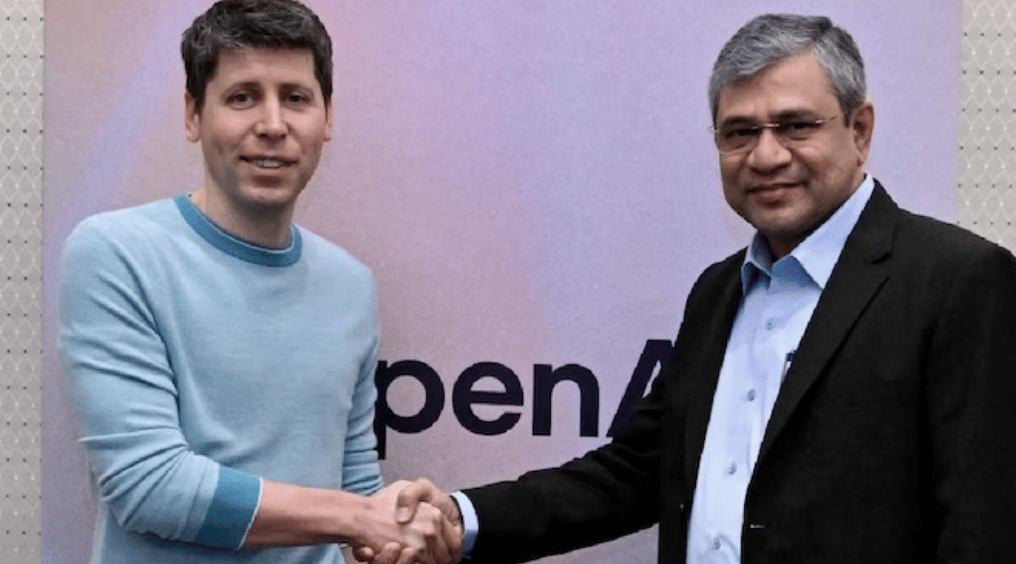
OpenAI CEO with India’s Minister for Information & Broadcasting, Electronics & Information Technology. Photo Credit: India Today.
In the late 18th and early 19th centuries, a system of trade existed between Britain, China, and India. The system known as the “Golden Triangle of Trade” was a defining economic system built on exploitation, monopoly, and imperial control rather than true reciprocity. At its core, it linked the East India Company’s dominance in India, the Chinese tea and silk trade, and Britain’s insatiable demand for these goods.
In this triangular flow, Britain imported tea, silk, and porcelain from China, paying in silver because the Chinese Qing Empire was largely self-sufficient and uninterested in most Western goods. To offset the outflow of silver, the British East India Company began cultivating opium in colonial India, particularly in Bengal and Bihar, and exporting it to China through smugglers. This helped reverse the drain of silver, and it began flowing from China to India and then to Britain, completing the triangle.
Cut to the 21st century, and a new global system of trade relies on data to secure the growth of the global economic system. Naturally, in this setup, when AI labs began their efforts to secure profits for their investors, securing both data and future markets, they looked to the east for its vast population, cultural diversity. Both of which are important markers for rich data and continued growth.
However, since the Chinese market is no longer easy to tap into, AI companies like Google and OpenAI focus their energies on India.
AI’s India pitch

Perplexity was one of the first major AI companies to set its eye on the Indian market. The company partnered with Indian telecom operator Airtel to offer a free 12-month Perplexity Pro subscription. Photo Credit: The Hindu.
The race to capture the Indian market was set off when, in January 2025, Microsoft announced it would be investing $3 billion over the next two years in its cloud and AI infrastructure, skilling, and partnerships in India. The investment, according to Microsoft, would be used to train 10 million people in AI in India by 2030.
The move was followed by Perplexity announcing it was partnering with Indian telecom operator Airtel to offer a 12-month Perplexity Pro subscription free of cost to all its 360 million customers.
Then, in July 2025, Google announced it would offer its Pro AI features to students in India for free. The India special offers included a free-for-a-year scheme for eligible college students.
In October, Anthropic announced plans to establish offices in the Indian city of Bengaluru to tap into local partnerships and talent base.
The announcement was closely followed by a similar move from OpenAI. The company announced it would open its first Indian office in New Delhi to establish a local team that could tackle backlash from news outlets and book publishers accusing the firm of using their content without permission to help train ChatGPT.
However, the ChatGPT-maker went one step further and offered its Go subscription free to users in India for one year. The plan, first launched, is OpenAI's most affordable offering and is currently priced at 399 rupees ($4.54) per month.
The latest announcement, however, comes from Google, which is now taking the same route as Perplexity to expand its Indian user base. The company is offering 18 months of free access to its Gemini AI service for all 505 million telecom users of India's Reliance Jio.
The announcement came close on the heels of the company committing to invest $15 billion in AI infrastructure capacity in India.
The announcements and investments are enough to understand that the Indian market is important for growth due to its large population. However, below the surface lies a deeper long-term strategy that could ensure AI dominance for a company that controls the Indian market.
India’s lure
According to the IT industry body Nasscom and consulting firm BCG, India’s AI market is projected to touch $17 billion by 2027, growing at an annualized rate of 25-35% between 2024 and 2027.
Key drivers of this growth are expected to be an increase in enterprise tech spending, the country’s expanding AI talent pool, and a rise in AI investments. However, this is just the tip of the iceberg.
India's developer ecosystem has become one of the most dynamic in the world, and the numbers tell the story. According to GitHub’s Octoverse 2024 report, India is the fastest-growing hub for developers globally, with over 21.9 million registered users. The figure is projected to surge to 57.5 million by 2030, surpassing even the United States in active developer population. This explosive growth reflects the convergence of several trends: the country’s maturing IT services sector, a massive youth demographic with strong STEM education pipelines, and the increasing accessibility of global open-source communities.
For chatbot makers like OpenAI and Google, this presents a unique opportunity as AI assistants are shaping developer workflows in India faster than almost anywhere else. As such, ensuring early adoption by users will ensure their tools remain a focal point for future use cases.
Additionally, generative AI coding tools like GitHub Copilot, Amazon CodeWhisperer, and OpenAI’s GPT-powered integrations are being used to automate documentation, code reviews, testing, and debugging by IT services firms, software consultancies, and startups.
According to a Reuters report, a survey conducted by EY suggests that this shift is already underway. Top Indian IT companies such as TCS, Infosys have started trialing GenAI projects, with 33% of the respondents of the survey saying they are already in production. AI tools are being embedded into delivery pipelines, which can then be marketed to global clients as proof of faster turnaround times and reduced human error.
Subsidizing access today can lock in developer mindshare and drive downstream enterprise deals.
Favorable cultural and political atmosphere
AI labs need massive amounts of data to train their models. Giving free access to users in India not only gives companies access to their data but also ensures that this data is linguistically diverse. India is home to over 22 official languages, which allows companies to improve the performance of their foundational models and increase accuracy in low-resource Indian languages, a critical feature for local relevance.
Adoption of regional languages also allows companies to capture the next wave of internet users in Tier 2 and Tier 3 cities who will interact with the internet primarily through local languages and possibly chatbots.
The current administration AI policy framework has rapidly evolved over the past few years, anchored by the IndiaAI Mission, which was formally approved by the Union Cabinet in March 2024 with a budget of more than ₹10,300 crore (about US $1.25 billion). The mission aims to create a unified ecosystem for artificial intelligence development, adoption, and governance. It focuses on building domestic compute infrastructure (a proposed 10,000+ GPU grid), creating open datasets, funding AI startups, advancing skill development, and promoting responsible and ethical AI use.
India’s regulatory landscape also provides advantages that may not be available in other regions. The country’s Digital Personal Data Protection Act (DPDP) takes a blacklist approach to cross-border data: transfers are allowed to any country unless the government later names it as restricted, allowing companies to use local data unless they are otherwise told not to.
All these ensure that AI companies can continue to scale in the country, even if it comes at the expense of local startups. Critics warn that India’s AI pricing surge could devolve into a “race to the bottom”.
Hit to local growth of AI labs
They argue that ultra-low and free subscriptions mirror India’s streaming wars, where deep price cuts eroded average revenue per user and forced consolidation. Such tactics might win market share but create unsustainable economics in the long term.
Additionally, deepfake-labeling rules and enforcement of the Digital Personal Data Protection (DPDP) Act could increase compliance costs and slow the rollout of higher-risk features such as AI-generated images, videos, or political content.
Local startups face additional strain as free bundles from global firms could undercut smaller Indian AI companies before they mature, echoing concerns already flagged in the country’s competition commissions (CCI’s) new rules on predatory pricing.
So, while Indians may currently have access to free and subsidized AI tools, the model may upend the country’s IT service sector in the long run.
A modern version of global trade is well on its way. The modern AI economy can be seen as a 21st-century Golden Triangle, powered by invisible trade routes of information rather than ships and spice. The risk, as before, is that the benefits will be unevenly distributed, unless global governance catches up to ensure that this time, intelligence itself is not colonized.

Bite-Sized Brains
Apple taps Gemini for Siri: The next Siri upgrade will rely on Google’s Gemini AI, not Apple’s in-house models, signaling a major shift in AI strategy.
Meta’s AI can’t find its product-market fit: Despite billions in investment, Meta’s consumer AI tools are floundering—with unclear utility, weak retention, and mounting internal tension.
Microsoft’s Zune moment, revisited: A new retrospective explores why Zune failed—and what it got weirdly right about today’s creator economy.
Framer is giving early-stage startups a full year of the Pro Plan—completely free.
Framer is the design-first web builder that helps startups launch fast. Join hundreds of YC founders already building on Framer.
Who's Eligible? Pre-seed and seed-stage startups. Offer available to new Framer users only.
What You Get:
✅ 1 year of Framer's Pro Plan ($360 value).
✅ Fast, professional site—no dev team needed.
✅ Scales with your startup.
*This is sponsored content
Prompt Of The Day
 | You’re leading OpenAI’s expansion into India. You’ve already dropped free subscriptions, launched a local office, and developers are starting to adopt your tools.Now what? What do you launch next, and how do you turn early traction into long-term dominance without burning through cash or trust? |
Tuesday Poll
🗳️ Which AI labs will dominate the Indian market by 2030? |
Rate This Edition
What did you think of today's email? |