- Roko's Basilisk
- Posts
- The Physical AI Gamble
The Physical AI Gamble
Plus: Reddit checks humans, Polymarket stumbles, Meta & YouTube lose.

Roko's Basilisk
March 27, 2026
Here’s what’s on our plate today:
🧪 Skild’s robot-brain bet and the real test of physical AI.
🧠 Reddit verifies humans, Polymarket stumbles, Meta & YouTube lose.
🧰 Weekend To-Do: Skild AI, Isaac Sim, and Figure.
🗳️ Friday poll on what Skild is actually selling right now.
Let’s dive in. No floaties needed…

🌱 Framer for Startups

First impressions matter. Launch a stunning, production-ready site in hours with Framer, no dev team required. Early-stage startups get one year of Framer Pro free, a $360 value. No code, no delays. Scale from MVP to full product with CMS, analytics, and AI localization. Trusted by hundreds of YC-backed founders.
*This is sponsored content
The Laboratory
One model, every robot: Inside Skild’s ambitious plan to crack physical AI
TL;DR
One model for many robots: Skild’s “omni-bodied” foundation model is designed to run quadrupeds, humanoids, arms, and mobile robots without task-specific rewiring, and to learn from video, simulation, and real-world feedback.
Foxconn is the real test: Skild says its model will power robots on Foxconn’s Houston lines building NVIDIA racks, while ABB and Universal Robots give it a faster path onto real factory floors.
The valuation assumes a future category winner: Skild is valued at $14B on about $30M in revenue, which only makes sense if investors believe it will dominate a robotics market that barely exists yet.
Skeptics have receipts: Rodney Brooks argues robot dexterity is still far behind human hands, and past failures like Rethink Robotics show how fast factory-floor reality can kill impressive demos.
The demand is real even if the tech is early: With $1.2T in new U.S. manufacturing investment and labor shortages everywhere, the pressure to make physical AI work is real, even if the timeline is not.
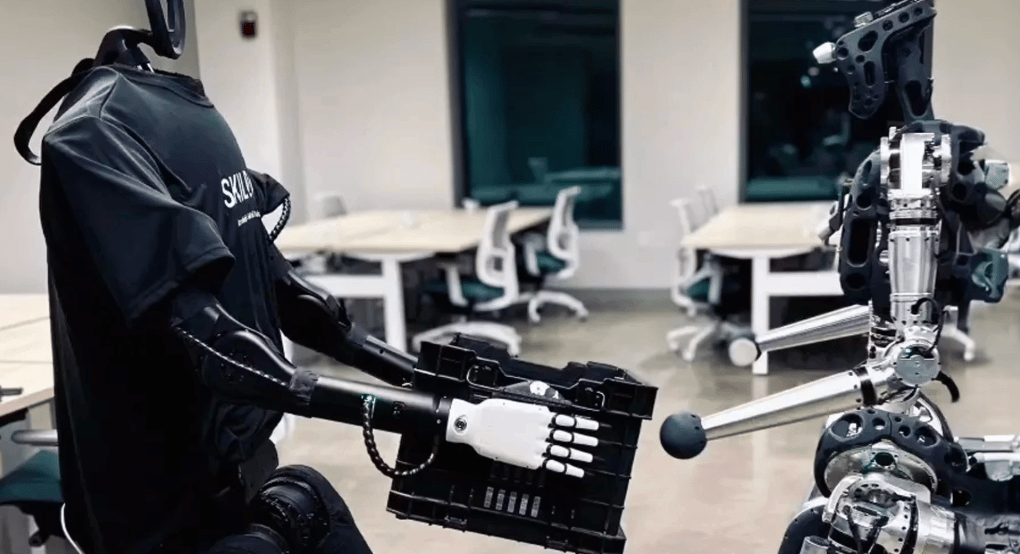
Skild AI, headed by Deepak Pathak and Abhinav Gupta, says it is building a general-purpose robotic intelligence designed to learn at scale and adapt to real-world situations. Photo Credit: The Information.
Science fiction taught us that when artificial intelligence finally became real, it would arrive in the form of robots capable of doing physical work as easily as humans. Reality, though, has been slower and far less dramatic, and the path to dexterous machines, it turns out, is paved with failed experiments and hardware limitations. Despite the challenges, incremental breakthroughs, and each small advance are laying the groundwork for the next innovation that could bring science fiction to life.
On 16 March 2026, Skild, a Pittsburgh-based robotics startup, contributed to this process by announcing that its general-purpose robotics foundation model would power robots on Foxconn’s Houston assembly lines, where NVIDIA’s Blackwell GPU server racks are built.
The very same day, the company also announced partnerships with ABB Robotics and Universal Robots to embed its software across their industrial robot portfolios. The announcement landed during NVIDIA’s GTC 2026 conference, where CEO Jensen Huang projected $1T in orders for its Blackwell and Vera Rubin systems through 2027 and made Physical AI a central keynote theme.
The announcements are part of broader efforts to develop autonomous factories to meet NVIDIA’s infrastructure buildout targets. And in the words of Deepu Talla, NVIDIA’s vice president of Robotics and Edge AI, Skild’s deployment is an early commercial test of whether AI can finally cross from digital intelligence into the physical world.
From science fiction to factory floors
Although many companies are working to bring AI to the physical world, Skild stands out for its unique approach. The startup headed by Deepak Pathak and Abhinav Gupta, both former professors at Carnegie Mellon University’s Robotics Institute and former researchers at Meta’s FAIR lab, believes that robotics has been stuck for decades because the hardware lacks the general-purpose brain to power its motions.
The philosophy has some truth to it. You see, conventional industrial robots must be carefully programmed by human experts, task by task, for each specific environment. Changing a single step in an assembly process can require weeks of re-engineering. Skild’s approach inverts this: instead of programming a robot for a task, you train a foundation model on vast quantities of data and deploy it across any robot body.
The model, called Skild Brain, is described as ‘omni-bodied,’ meaning it can control quadrupeds, humanoids, tabletop arms, and mobile manipulators without task-specific reprogramming. It is trained on data from multiple sources: billions of human action videos scraped from the internet, teleoperation recordings, simulated environments built using NVIDIA’s Cosmos World Foundation models and the Isaac Simulation Platform, and real-world deployment data that feeds back into the model over time.
Once pre-trained, the brain is fine-tuned with small amounts of robot-specific data and runs locally on NVIDIA Jetson edge computing chips installed on each machine.
In simple terms, the company is building the intelligence layer that sits on top of robots made by other companies. The analogy Skild and its investors reach for is Android: a shared operating system for hardware produced by different manufacturers, creating a data flywheel where every new deployment makes the shared model smarter for everyone.
The money behind the thesis
Skild’s philosophy has the backing of the investment community. The company has raised more than $2B in funding in less than two years, as investors bet big on AI for robotics. It raised $300M in July 2024 at a $1.5B valuation, backed by Lightspeed, Jeff Bezos, SoftBank, Sequoia, and Amazon.
A $500M round in May 2025 pushed its valuation to $4.7B, and just seven months later, a SoftBank-led $1.4B round valued the company at over $14B, according to TechCrunch. On a wider scale, other companies operating on a similar hardware-agnostic model have broadly raised $13.8B in 2025, up from $7.8B the year before, according to Crunchbase data.
However, despite the new approach and investor backing, not everyone agrees that robots will have the dexterity to compete with humans anytime soon.
The skeptics
According to Rodney Brooks, one of the most influential figures in modern robotics and AI, the current excitement around general-purpose robots looks familiar. Brooks, who co-founded iRobot and later built industrial robots at Rethink Robotics, has spent decades working at the intersection of AI and physical machines. In his 2026 predictions, he wrote that robot dexterity will remain far behind human hands for at least another decade, calling the idea that robots can learn complex movements simply by watching videos ‘pure fantasy.’ Human hands contain thousands of specialized touch receptors that today’s robots still cannot replicate.
His skepticism is aimed partly at humanoid-robot startups but also applies to the broader push toward general-purpose physical AI. Large language models advanced quickly because they could train on the vast amount of text available on the internet. There is no comparable dataset for real-world movement, and current AI systems still struggle to understand the three-dimensional physical world.
Brooks’ own experience offers a cautionary example. Rethink Robotics built collaborative robots designed to work safely alongside humans, but the added safety compromised their precision compared to traditional industrial machines. Manufacturers rejected the trade-off, sales declined, and the company shut down in 2018, a reminder that what works in a demo does not always survive the realities of the factory floor.
The factory floor will decide.
What this means for the current market and the tech enthusiast waiting for robots to take over laundry duties is that, realistically, the demand signal is real, even if the technology is early.
At the same time, dismissing the Skild deployment as pure hype would miss an important demand-side shift. New U.S. manufacturing investments worth approximately $1.2T were announced in 2025, led by electronics, pharmaceutical, and semiconductor manufacturers.
Industry executives say large-scale reshoring will only work with much higher automation. Manufacturers are already facing labor shortages due to aging populations, according to the International Federation of Robotics, which is why automation is increasingly framed as a response to worker scarcity, even though it can also reduce labor needs.
NVIDIA is also betting that automation will help it achieve its huge chip-manufacturing expansion, which depends on factories that can scale faster than human hiring allows, creating a feedback loop in which AI infrastructure may require AI-powered robots to build it.
That is also why Skild’s partnerships with ABB and Universal Robots could matter more than any single deployment. Instead of building its own hardware, Skild can plug into robot arms already used across global manufacturing, giving its software a faster path onto factory floors.
For now, the message is that even if AI is not yet ready for the physical world, companies like Skild are moving fast to make it a reality.
Skild’s $14B valuation, against roughly $30M in revenue, suggests investors are betting on the company dominating a category that does not yet fully exist. For comparison, ABB’s entire robotics division, which generates about $2.3B in revenue and has decades of customer relationships, sold for $5.4B.
Skild is valued at nearly three times that, with only a fraction of the business. If the idea of general-purpose robot “brains” fails to scale, the correction could be sharp.
Whether that vision becomes real will depend on whether Skild’s approach can solve problems that are not purely software-related, such as mechanical precision, materials handling, and process engineering, where robotics has struggled for decades. Investors are betting that this time, robotics will follow the same curve as AI. The factory floor, not the demo stage, will decide if they are right.

Headlines You Actually Need
Reddit checks for humans: Reddit will now label approved bots and require suspicious accounts to prove they are human, using signals like posting speed plus tools such as passkeys, biometrics, or IDs in some regions.
Polymarket’s bar flopped: Polymarket’s new “Situation Room” pop-up in DC was supposed to be a news-watching sports bar, but its giant wall of screens reportedly failed almost immediately, which is not ideal for a venue built around monitoring “the situation.”
Meta & YouTube lose: A Los Angeles jury found Meta and YouTube liable for designing addictive products that harmed a young user, awarding $3M on in compensatory damages in the first social media addiction case of its kind to reach trial.
Outperform the competition.
Business is hard. And sometimes you don’t really have the necessary tools to be great in your job. Well, Open Source CEO is here to change that.
Tools & resources, ranging from playbooks, databases, courses, and more.
Deep dives on famous visionary leaders.
Interviews with entrepreneurs and playbook breakdowns.
Are you ready to see what’s all about?
*This is sponsored content
Friday Poll
🗳️ What is Skild really selling to the market right now? |
Weekend To-Do
Skild AI: Read how it frames “omni-bodied” robot intelligence and decide whether this feels like Android for robots or just very expensive optimism.
NVIDIA Isaac Sim: Explore the simulation stack behind much of the physical AI hype and see how much of modern robotics is really software and synthetic environments.
Figure: Compare Skild’s software-first thesis with a company building the full humanoid stack, hardware, model, and deployment together.
The Toolkit
Dust: AI workspace that lets your team build secure copilots on top of internal docs, apps, and data.
Krea: Real-time AI canvas for generating and editing images or video from text prompts and sketches.
Lavender: AI sales email coach that scores your drafts, suggests edits, and improves reply rates.
Rate This Edition
What did you think of today's email? |