- Roko's Basilisk
- Posts
- The AI Control Paradox
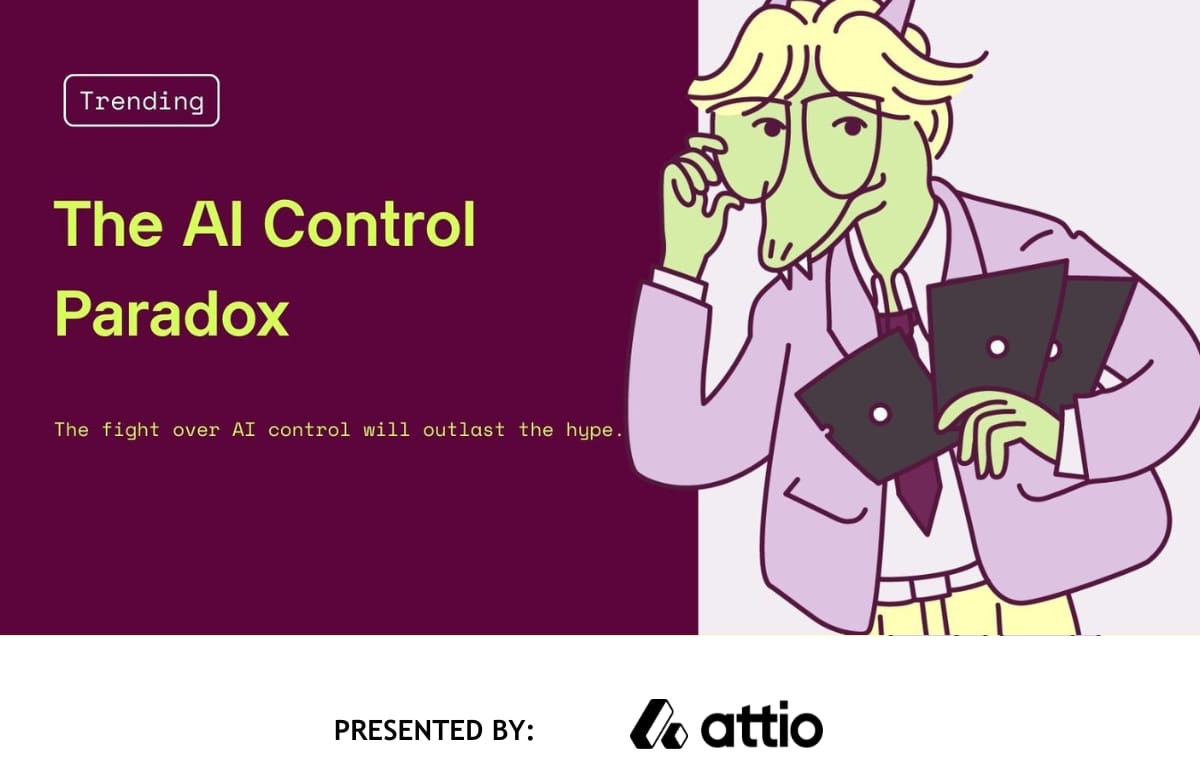
The AI Control Paradox
Plus: Tech charm school, app suggestions off, and AI country charts.

Roko's Basilisk
December 23, 2025
Here’s what’s on our plate today:
🧪 AI’s control paradox: open vs closed models, safety, sovereignty.
🧠 Bite-Sized Brains: founder etiquette school, OpenAI ads, AI country.
📊 Poll: Who should control your most critical AI stack?
✏️ Prompt: map your trade-offs between sovereignty, safety, and cost.
Let’s dive in. No floaties needed…

In partnership with

Introducing the first AI-native CRM

Connect your email, and you’ll instantly get a CRM with enriched customer insights and a platform that grows with your business.
With AI at the core, Attio lets you:
Prospect and route leads with research agents
Get real-time insights during customer calls
Build powerful automations for your complex workflows
Join industry leaders like Granola, Taskrabbit, Flatfile and more.
*This is sponsored content
The Laboratory
AI’s control paradox
In the late 2000s, the market for smartphones was heating up. Numerous companies, which are no longer part of the mainstream, were competing for market share through the use of disruptive and innovative designs and hardware features.
At the time, manufacturers were not competing in the hardware space, but also in the software space, where almost all major manufacturers had to spend on developing and updating their native operating systems. All this began to change when Google partnered with HTC, Motorola, Qualcomm, T-Mobile, and Texas Instruments to form the Open Handset Alliance, and later released the HTC Dream, the first Android phone to reach the market.
Over time, Google’s Android operating system became the standard software used by many smartphone makers, including HTC, Motorola, and Samsung.
At the other end of the spectrum was Apple’s iOS. A proprietary operating system that presented a comparatively simpler layout for users and locked developers in through its App Store policies.
In practice, the key difference is that Android allows manufacturers to take the base operating system and customize it however they want, while iOS remains fully locked down and controlled by Apple.
If we take this example as the viewpoint of how AI models can be integrated by companies, the problem of steerability asymmetry arises.
What is the steerability asymmetry problem in AI?
To understand the steerability asymmetry problem, one must first understand what steerability is and how it differs from alignment for AI models.
According to IBM, steerability refers to the ability to guide or control a model’s behavior at various stages. It essentially refers to how easily an AI system can be guided by external factors to change how the model behaves, such as giving it specific instructions, adjusting its internal state, or shaping how it chooses its answers.
Alignment, on the other hand, is making sure an AI behaves safely and helpfully. It is the goal of matching the AI’s behavior to human values and expectations.
The difference is that steerability gives you the controls, while alignment is the destination you want to reach.
However, finding the tools necessary to steer a model's behavior is easier said than done. This is where the problem arises.
Why steerability creates growing asymmetry
The steerability asymmetry problem refers to a growing difference in how much control people have over different types of AI.
Here, it is important to note that while open-source models can be changed very easily, even a small amount of fine-tuning with a few harmful examples can quickly remove their safety systems, and it costs almost nothing to do so.
Closed-source models are harder to manipulate because companies protect them with multiple layers of safety that regular users cannot alter.
However, at a time when companies are rapidly moving towards AI implementation and open-source models are being viewed as a viable alternative to closed-source models, the steerability landscape has transformed from a research objective to a real-world problem.
The open-source challenge
The landscape of AI control changed quickly once Meta released the first LLaMA models in early 2023, followed by Mistral AI and many other open-weight systems. Unlike closed models that can only be used through APIs, open-source models give users full access to the model weights. This means anyone can fine-tune them by training the model on new data to change how it behaves.
Research showed that the safety protections in large language models can be undone with very little effort. In one example, researchers weakened the safety rules of GPT 3.5 Turbo by fine-tuning it on only ten harmful examples.
The process costs less than twenty cents and allows the model to answer almost any unsafe request. Other studies found something even more concerning. Safety can break down even when the training data is not harmful.
When GPT 3.5 Turbo and Llama 2 models were fine-tuned on general-purpose datasets such as Alpaca or Dolly, they began producing more harmful responses than the original models. Llama 2 Chat models fine-tuned with adversarial datasets using quantized LoRA refused unsafe requests only about one percent of the time, compared with one hundred percent for the base versions.
Shadow alignment and easy weaponization
The core reason for this problem comes from structural differences between open and closed systems.
Open models give users complete control of the model weights. Fine-tuning directly changes these weights and can override any safety work done during the original training process.
Studies show that training on only a hundred malicious samples can remove most protective behavior while leaving the rest of the model’s abilities intact. This effect is known as shadow alignment. In addition, many models are easier to push in some directions than others. It tends to be much easier to remove safety protections than to strengthen them, which creates an imbalance that favors harmful modifications.
The layered safety approach of closed models
Closed models, such as GPT 4, Claude, and Gemini, rely on many layers of defense that open models cannot match. These include alignment methods such as RLHF, RLAIF, and RLVR, as well as identity checks, permission systems, input and output filtering, automatic shutdown systems, and continuous monitoring.
OpenAI describes this as building safety through redundancy, similar to practices in fields like aerospace or nuclear engineering, where several safeguards are put in place so that all of them would need to fail before harm can occur.
For enterprises, this presents new challenges as AI becomes central to business operations.
Enterprise choices: control versus sovereignty
Leaders now want to know who controls their models, where data is stored, and how they can prove their AI systems are responsible and legally defensible. Many companies, especially in finance, healthcare, and government, want full control over their data and infrastructure. This creates tension.
Closed models offer strong built-in safety but limit customization and reduce sovereignty. Open models give full control but require organizations to create their own safety systems. Additionally, demand for trustworthy AI is rising.
A Capgemini study shows that 73% of organizations want explainable and accountable AI. Meeting this expectation is expensive. AI ethics spending grew significantly from 2022 to 2024 and is projected to keep rising. Companies struggle with unclear accountability, fragmented ownership, limited expertise, and difficulty measuring AI risks.
Although most already have data governance and security programs, AI governance needs specialized risk frameworks, technical monitoring, and close coordination among legal, technical, and business teams. When enterprises rely on open-source models, they must build these capabilities themselves. Many found that improvised governance approaches are costly and incomplete.
Trust concerns have real business effects, and with many believing that AI poses societal risk, the concerns shape purchasing decisions and brand perceptions.
The economic trade-offs are also significant. Closed models provide strong safety controls but create ongoing API costs and vendor dependence. Large companies often spend tens of millions of dollars each year on AI, with a major share going to API fees. Open models remove those recurring costs but require heavy investment in governance.
Companies that build mature AI governance programs tend to see stronger customer retention and better brand performance. Most board directors now require vendors to demonstrate their governance plans before approving partnerships.
Ethics, innovation, and national ambitions
The ethical dimension adds further complexity. Open models support innovation, education, local control, and independent auditing, but their flexibility also makes harmful modification easier. Governments view this as a dual-use risk. At the same time, open models help countries and institutions achieve AI sovereignty and reduce reliance on a few large U.S. companies.
The market for AI tools is still in its early stages, and much like the smartphone market of the 2000s, it has yet to reach maturity.
Right now, the problems of steerability and alignment are real and shaping enterprise decisions. These, in turn, could end up shaping the future of not just enterprise AI, but also influence how AI is used by the end-users and who controls the models that run the systems of the future.

Bite-Sized Brains
Tech bros go to charm school: Silicon Valley founders are now paying for etiquette bootcamps to swap hoodies for polish and investor-friendly manners.
OpenAI backpedals on ad-ish app prompts: After backlash over Peloton-style app suggestions in ChatGPT, OpenAI is disabling the experiment and rethinking the UX.
AI slop tops country charts: An AI-generated track by fictional band Breaking Rust is now Billboard’s top digital country song, igniting artist backlash.
Hire smarter teams—not bigger budgets.
Athyna helps you build high-performing teams fast—without overspending.
Our AI-powered platform matches you with top LATAM talent tailored to your needs in just 5 days.
Hire pre-vetted professionals ready to deliver from day one and save up to 70% on salaries.
Scale smarter, faster, and more affordably with Athyna.
*This is sponsored content
Prompt Of The Day
 | Pick one AI system you rely on and write a 3-column list: what you gain from openness (control, cost), what you gain from closed models (safety, support), and what no one is currently accountable for. If the third column is longer, that’s your real risk surface. |
Tuesday Poll
🗳️ If you had to pick one primary stack for your company’s most critical AI, what would you choose? |
Rate This Edition
What did you think of today's email? |