- Roko's Basilisk
- Posts
- When Bots Replace Readers
When Bots Replace Readers
Plus: IBM’s $11B move, AI-assisted flirting, and Anthropic’s internal guiding manifesto.

Roko's Basilisk
December 17, 2025
Here’s what’s on our plate today:
🧪 How AI is gutting publisher traffic and business models.
🧠 Quick Bits: IBM–Confluent deal, Hinge’s AI, Claude’s “soul.”
📊 Poll: Will people read news or just AI summaries?
🧱 Brain Snack: rewrite content assuming AI is your main reader.
Let’s dive in. No floaties needed…

In partnership with

Get the investor view on AI in customer experience

Customer experience is undergoing a seismic shift, and Gladly is leading the charge with The Gladly Brief.
It’s a monthly breakdown of market insights, brand data, and investor-level analysis on how AI and CX are converging.
Learn why short-term cost plays are eroding lifetime value, and how Gladly’s approach is creating compounding returns for brands and investors alike.
Join the readership of founders, analysts, and operators tracking the next phase of CX innovation.
*This is sponsored content
The Laboratory
The real impact of AI on digital media

As online audiences grow, AI threatens the business models publishers built for the web. Photo Credit: Forbes.
In the 1990s, when the internet opened for public use, it transformed how information moved across the world. Until then, only the invention of the printing press had created a similarly dramatic shift in how information was produced and shared.
The printing press did more than introduce a new technology. It created an entirely new business model, one that publishers refined for centuries as advances in printing and distribution helped them grow.
Today’s publishing industry straddles both the physical and digital worlds. Most books, newspapers, magazines, and other media now exist in both formats, reflecting a marketplace that is still evolving.
Yet as online usage continues to rise, many publishers that were slow to embrace digital transformation are struggling for visibility. And just as they were beginning to adapt, a new technology has emerged that threatens the business models they built for the internet era.
How AI is rewriting the search relationship
The relationship between tech platforms and publishers has always been uneasy, but the rise of AI has changed that tension in a new way.
For years, publishers relied on search engines to gain visibility in the online space. Search engines such as Google worked on a simple exchange. They scanned websites, indexed the information, and sent users back to those sites through search results. Publishers accepted this system because the traffic they received helped them earn advertising revenue, sell subscriptions, and build loyal audiences.
With the advent of AI chatbots, everything began to change.
According to research from the analytics firm Originality.AI, a growing share of visits to news sites now come from AI bots rather than people.
However, these automated visits do not turn into real readership. Large language models (LLMs) from companies including OpenAI, Anthropic, Google, and Meta pull in enormous amounts of online content to train their systems and answer user questions.
When someone asks ChatGPT or Claude about a news story, the response is generated instantly from many sources. The user receives the answer on the spot and has little reason to click through to a publisher’s site.
It is estimated that OpenAI’s GPT-3 learned from about 570 gigabytes of text scraped from the public internet.
Newer models such as GPT-4 and Claude could likely draw on much larger datasets. Publishers say they have seen traffic from AI crawlers like GPTBot, ClaudeBot, and Google-Extended, but they also suspect that many bots disguise their activity or route it through other channels, which makes the true scale hard to measure.
The economic stakes for publishers
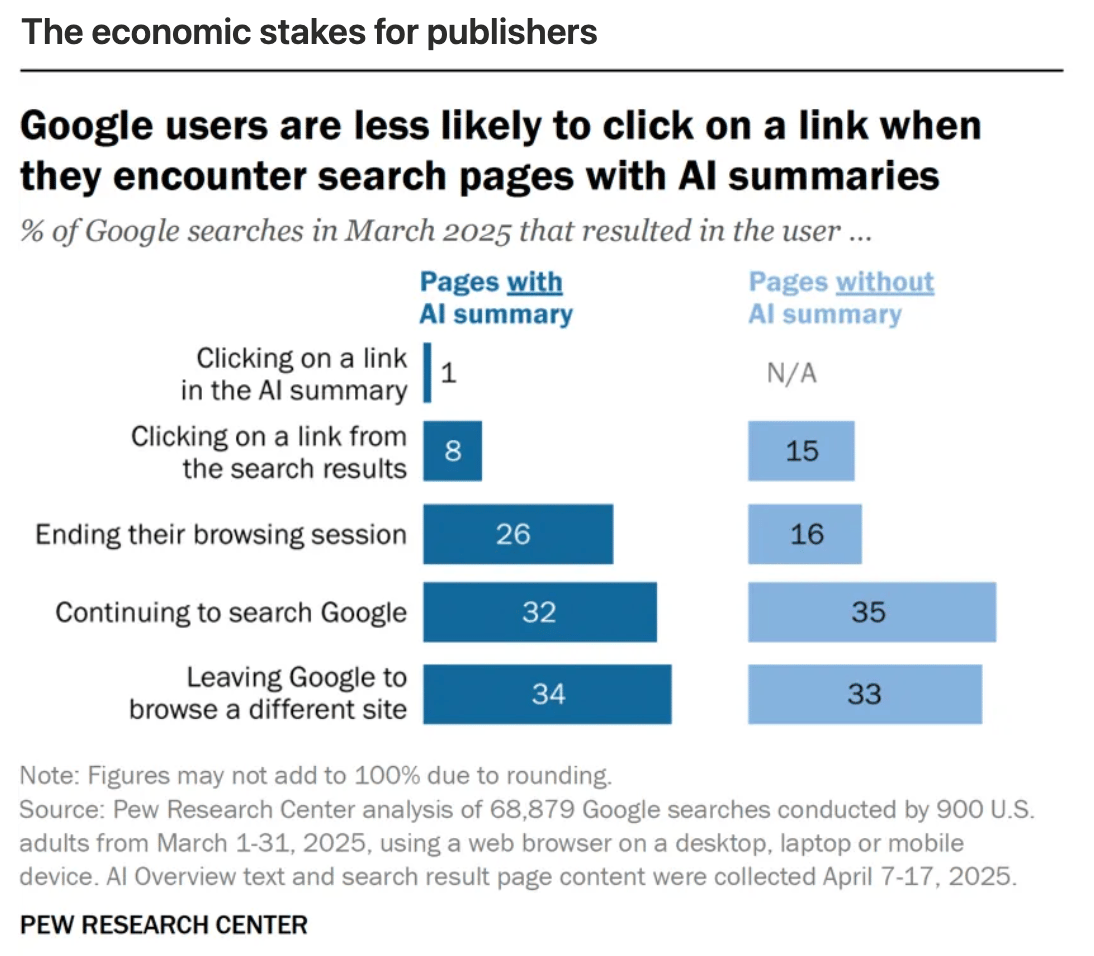
The timing of this shift could not have come at a worse time to publishers. According to the Reuters Institute’s Digital News Report 2024, publishers continue to struggle with falling trust, shrinking revenue, and audiences that are splitting across many platforms.
Advertising income is also yet to recover to pre-2020 levels, and subscription growth has slowed for many outlets.
Now, AI threatens to reduce what little value publishers still receive from traditional web traffic.
The value of user visits
Traditional web metrics like page views, unique visitors, and time on site lose much of their value when large amounts of traffic come from AI bots. These bots collect information but never see ads, paywalls, or subscription prompts.
Press Gazette has reported that publishers are receiving huge volumes of traffic from AI crawlers that generate no revenue at all.
This traffic still creates costs. Each bot request uses server power, bandwidth, and engineering time. For smaller outlets with thin margins, the expense can be significant.
Meanwhile, AI companies claim they can train models on publicly available content under fair use. Publishers argue this is a commercial use of their work without permission.
Licensing, legal battles, and uneven power dynamics
To counter this, some news organizations have chosen to license their content to AI companies rather than fight over it.
The Associated Press partnered with OpenAI in July 2023. Axel Springer followed in December 2023, and the Financial Times signed its own agreement in April 2024.
These deals benefit large publishers with recognizable brands, but smaller outlets often lack bargaining power.
The News Media Alliance says that fair compensation from AI companies could mean billions in annual revenue for the industry, but without regulation, the advantage sits with the tech companies.
Beyond the question of recently published material, there is another concern.
By licensing their archives, publishers risk legitimizing the idea that AI companies can use news content for training. Those who refuse to participate may find themselves left out of AI-generated answers entirely, reducing their visibility even further.
Some publishers have tried to block AI crawlers through robots.txt files. The New York Times did this in August 2023, and others have followed. The strategy has limits. It only works if companies respect the rules; it does not stop less transparent scraping methods, and blocking could mean losing any mention in AI assistants.
Meanwhile, AI companies often compare themselves to search engines, pointing to the long-standing practice of crawling websites. But the comparison falls apart when viewed through the lens of visibility.
Search engines drove users to publisher sites. However, AI assistants act more like replacements. They gather information from multiple sources and deliver full answers to users, removing the need to click through.
Publishers say declining web traffic is tied to features like Google’s AI Overviews, showing that AI is not extending the search model but disrupting it.
Further, AI companies also argue that they're building transformative technology that benefits society broadly.
OpenAI's charter emphasizes ensuring artificial general intelligence "benefits all of humanity." From this perspective, restricting access to training data would slow innovation and concentrate AI development among companies wealthy enough to license content at scale, potentially big tech firms that already dominate digital markets.
To placate publishers’ growing concerns, some AI companies are testing ways to add citations that link back to the sources. Perplexity promotes its citation system as a key feature, and OpenAI’s “Browse with Bing” mode in ChatGPT includes links to the sites it pulls from.
If these tools become the norm, AI assistants could start to resemble upgraded search engines that give answers while also sending some traffic to publishers.
What comes next for the publishing industry
However, regardless of how the story shapes up from here, there is no denying that AI is disrupting the foundational business model of many online publishers, just like the internet disrupted the business of many publishers of physical material.
The coming years will be challenging for publishers; however, if history is anything to go by, the flow of information will continue.
The printing press made the publishing industry what it is today, a force to be reckoned with. The internet challenged its very foundation while at the same time democratizing the flow of information. With AI, publishers will have to rethink both their role as distributors of information and, once again, adapt to disruptive technological advances.

Quick Bits, No Fluff
IBM drops $11B on Confluent: Big Blue is buying the data-streaming firm to beef up real-time pipes for cloud and AI.
Hinge hires an AI wingmate: The dating app’s new feature coaches your prompt answers so you stop opening with “hey.”
Anthropic’s “soul doc” leaks: A revealed internal manifesto shows how Claude is being steered with something like a written conscience.
Goodies delivered straight into your inbox.
Get the chance to peek inside founders and leaders’ brains and see how they think about going from zero to 1 and beyond.
Join thousands of weekly readers at Google, OpenAI, Stripe, TikTok, Sequoia, and more.
Check all the tools and more here, and outperform the competition.
*This is sponsored content
Brain Snack (for Builders)
 | Pick one piece of your content (blog, docs, or help center article) and redesign it as if an AI assistant —not human— is the primary “reader.” Make the core answer obvious in the first 3-4 sentences, structure supporting detail in clean sections, and add a single, high-value call to action that still makes sense if the user never lands on your site. |
Wednesday Poll
🗳️ Five years from now, where do you think most people will get explanations of the news? |
Rate This Edition
What did you think of today's email? |
