- Roko's Basilisk
- Posts
- Brains Before Biceps, Finally
Brains Before Biceps, Finally
Plus: ChatGPT fails patients, Cameron’s AI fears, Amazon cancer risks.

Roko's Basilisk
December 02, 2025
Here’s what’s on our plate today:
🧪 How AI is shaping the future of robotics.
📰 ChatGPT fails patients, Amazon is linked to illness, and Cameron rants.
🤖 Your robot roommate keeps misreading emotions.
🗳️ Monday Poll: Would you want a robot coworker?
Let’s dive in. No floaties needed…

Visa costs are up. Growth can’t wait.

Now, new H-1B petitions come with a $100k price tag.
That’s pushing enterprises to rethink how they hire.
The H-1B Talent Crunch report explores how U.S. companies are turning to Latin America for elite tech talent—AI, data, and engineering pros ready to work in sync with your HQ.
Discover the future of hiring beyond borders.
*This is sponsored content
The Laboratory
How AI is changing the fortunes of robotics
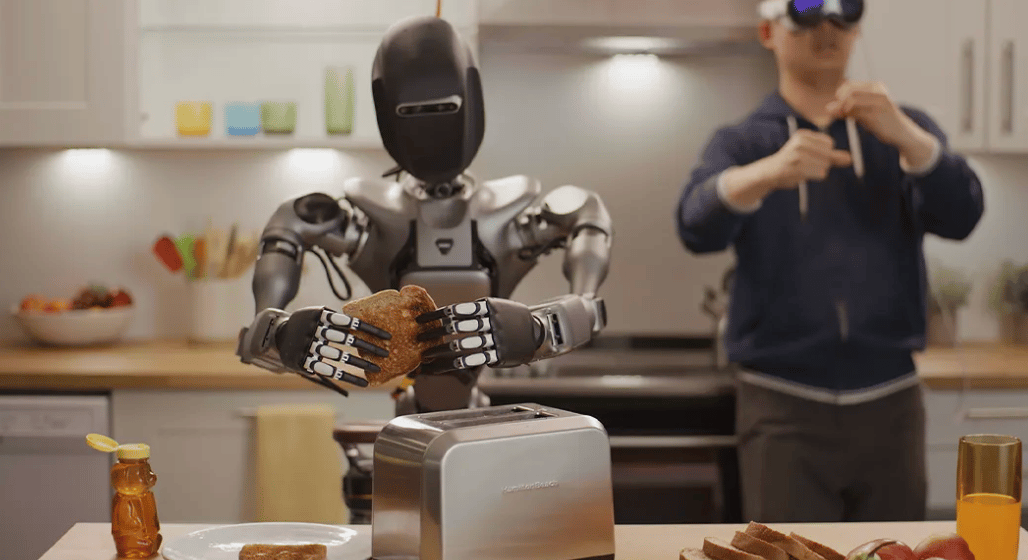
Stanford unveiled BEHAVIOR-1K at NVIDIA GTC 2024, a new benchmark for teaching robots 1,000 everyday tasks. Photo Credit: Nvidia.
Robots hold a special place in science fiction. Whether they are depicted as moving geometric structures or human-like beings, pop culture often portrays them as machines capable of understanding human emotions, mimicking human movements, and even having thoughts and beliefs of their own.
Beyond sci-fi, however, the field of robotics has struggled to stick to timelines. And though robots have been deployed in the past for various processes, their functioning has been limited to performing simpler tasks and taking up roles that would have otherwise been dangerous for human workers.
In 2022, when OpenAI first announced the launch of its artificial intelligence models, many thought it would usher in the age of robots, allowing humans to once and for all bid goodbye to doing household chores.
This has so far proved to be a distant dream. However, it does not mean that the advent of AI has not helped fast-track development in the field of robotics.
How AI helped improve robotics
Historically, one of the biggest challenges in making robots more capable has been developing reliable AI with human-like perception and reasoning abilities to operate effectively in unstructured, real-world environments.
Within research circles, this problem has a special term called Moravec’s Paradox, a term coined by the professor of robotics and futurologist Hans Moravec in the 1980s.
Forbes explains that Moravec was among the first to point out a major mismatch in technology. Computers can outperform top chess players and handle complex logic or creative tasks, yet they still struggle with basic physical actions that humans find easy.
However, the advent of powerful Large Language Models and multimodal AI paved the way for robots to transform from machines that follow fixed instructions to flexible systems that can work in messy, real-world situations.
And it is not just researchers who are excited about the possibilities of integrating AI models in robots.
The predictions start coming true
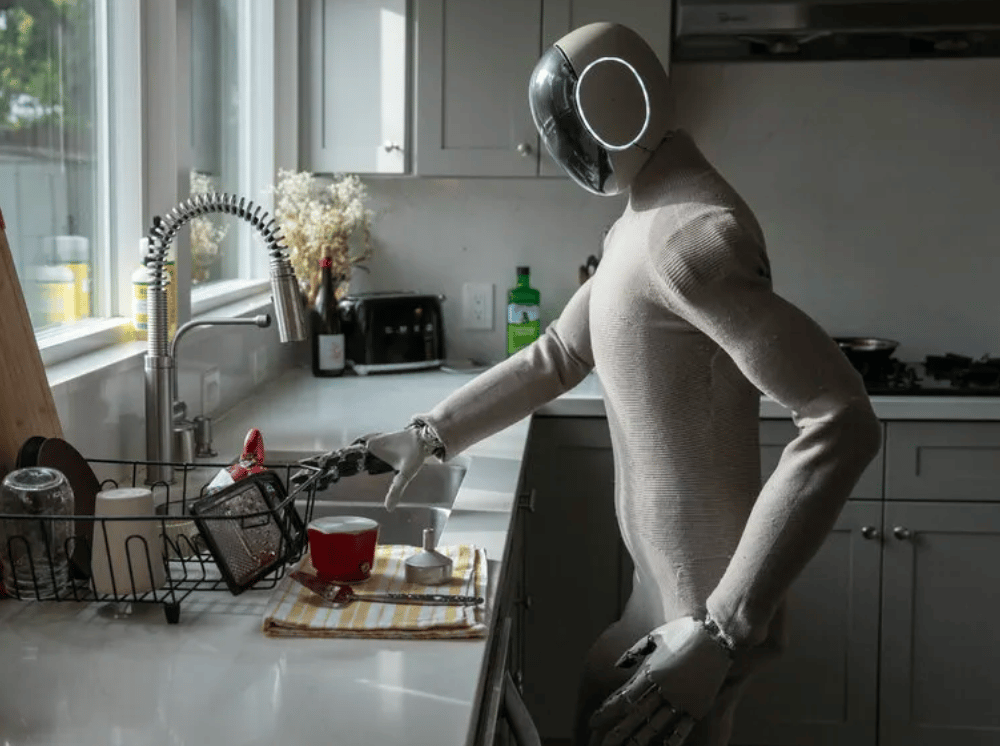
1X aims to place its humanoid robots in homes to collect real-world data from everyday chaos. Photo Credit: NYT.
In an interview with Wired, when asked which research area excited him the most, and had the potential to transform everything. Nvidia CEO Jensen Huang gave a direct answer: robotics.
He explained that if AI can generate text and images, it can likely generate motion as well. And if it can generate motion, it can learn intent and produce a general form of physical movement. That means humanoid robots may be coming very soon.
Huang’s prediction from 2024 did not happen in a vacuum. Around the time, many companies were working on developing robots that could emulate human movement and understanding.
The result: in 2025, robots will be rolled out in areas like hotels, hospitals, warehouses, and even homes.
Between 2023-2024, researchers demonstrated that foundation models trained on massive datasets of text, images, and video could be used to give robots generalizable reasoning capabilities.
A fine example of companies developing models especially for physical tasks was seen when, in 2023, Google released its RT-2 model.
The model showed that robots could follow natural language instructions and transfer learning across tasks without task-specific programming.
Not to be left behind, OpenAI has also made investments in robotic companies like 1X and Figure AI.
These collaborations and resultant progress in the field have also translated into real dollars.
Big money bets on better robots
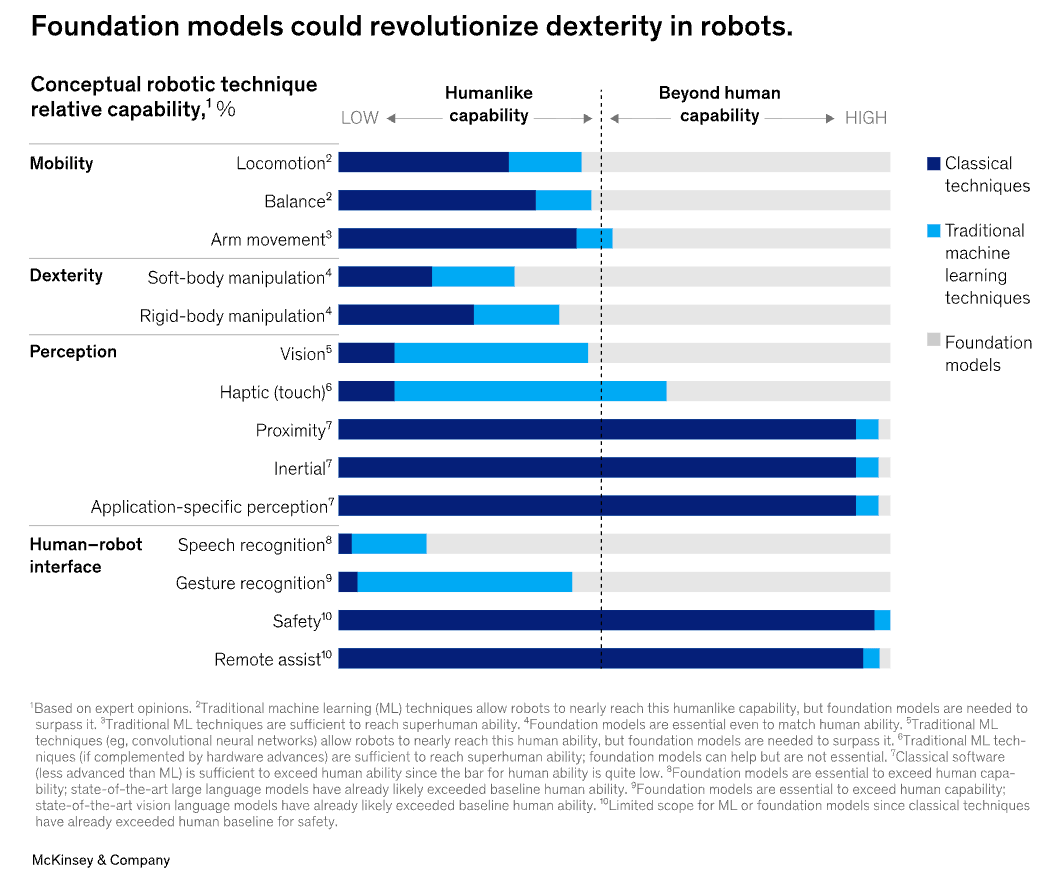
According to McKinsey, the robotics field is booming. Funding for general-purpose robots grew fivefold between 2022 and 2024 and now exceeds $1 billion a year.
Top start-ups like Figure AI, Skild AI, and Agility Robotics have each raised hundreds of millions.
Additionally, patent activity is rising quickly, with a growth rate of about 40% per year since 2022. It is estimated that if progress continues at the current rate, the general-purpose robotics market could reach a value of $370 billion by the year 2040.
So, companies are investing in developing both the hardware and the AI necessary for robots, but why are they yet to be seen in public spaces?
Where are robots actually working?
Robots have been improving, and investment is flowing into the sector. This has allowed companies to deploy the technology in multiple sectors. Currently, these include food service, where companies like Richtech Robotics and Bear Robotics have deployed robots in thousands of restaurants, and healthcare, where robots are being used to make up for staff shortages. In countries like Japan and Singapore, elder-care companion robots have moved into commercial use, though cultural acceptance differs.
Beyond service, robots are playing a major role in revamping the logistics sector. Here, robots are deployed in areas where, with the help of powerful AI models, they can handle irregular packages and update inventory changes without new programming.
It is estimated that Amazon alone uses around 750,000 robots in its warehouses. Dexterity AI’s picking robots are also estimated to be able to correctly handle more than 200 items with accuracy above 99%, matching or beating humans.
Another area where robots have increasingly been making headway is in residential use cases. Despite being difficult to build and deploy, 1X Technologies is testing home assistant robots in Norway, and Tesla plans to bring its Optimus humanoid to the mass market by 2026.
However, while the field of robotics has taken big strides in the past couple of years, not everyone is convinced that they are ready for mass adoption. And as always, some can be categorized as naysayers.
The skeptics point of view

Dockworkers hold a picket at Port Everglades in Fort Lauderdale, Florida. Photo Credit: FT.
Skeptics point to persistent capability gaps that marketing materials obscure. Rodney Brooks, robotics pioneer and former MIT professor, argues that foundation models give robots the illusion of understanding without genuine comprehension or robust error recovery.
He goes on to say that much of the public enthusiasm around AI and robotics is driven by hype. He urges caution, noting that many ambitious promises may turn out to be exaggerated. And he is not alone.
According to a 2024 study published in Science Robotics, even the most advanced robot systems struggle with long-tail problems. These are rare, unusual situations that humans handle easily, but robots find completely new and unpredictable.
It found that the current training methods cannot realistically produce the billions of unusual ‘edge-case’ examples needed for robots to perform reliably in every situation.
Widespread adoption of robots is also held up due to cultural and social stigma.
Labor groups say that claims of using robots to close the worker shortage hide deeper issues like low pay and poor working conditions.
The Economic Policy Institute argues that many shortages exist because employers won’t raise wages, not because workers are unavailable. From this view, robots don’t fix a real crisis; they help companies avoid improving jobs and working conditions, thereby hiding and not fixing the problem.
Studies from the University of Pennsylvania show that automation mostly benefits investors and highly skilled workers. People who lose jobs, especially those already vulnerable, face tough transitions. Without strong retraining programs and safety nets, robotics could worsen inequality.
Then there is the question of surveillance. Robots with cameras and sensors can collect detailed data on employees, enabling a form of constant monitoring.
Privacy experts say this creates algorithmic management that offers little transparency or ways for workers to challenge decisions.
What does the future of robots look like?
The advancements in AI have had a remarkable impact on the field of robotics. And with LLMs becoming even more powerful, the ability of robots is only expected to increase.
However, while robots become more capable, it is crucial to remember that capabilities cannot be the sole metric.
Studies in human-robot interaction show that people often treat robots as if they have real intelligence, intentions, or even moral status when the robots act in human-like ways. This creates risks around manipulation, emotional attachment, and misunderstanding machines that do not truly understand anything.
While science fiction has already placed ideas about what robots may look like and what they would be capable of, users today should not forget that while research may have come far enough to give AI a functioning body, the real challenge would be choosing the kind of human-robot future we want.
As such, while we may be capable of making science fiction come to life, we need to remember that not all depictions of robots revolve around them following human orders without any mischief or misuse.

Bite-Sized Brains
ChatGPT gave harmful advice: Psychologists warn AI gave dangerous answers to mentally ill users in new study.
Amazon data centers linked to illness: Report links cancer and miscarriages to Oregon facilities’ toxic emissions.
James Cameron slams generative AI: Avatar director says today’s AI tech is “horrifying” and creatively bankrupt.
The context to prepare for tomorrow, today.
Memorandum distills the day’s most pressing tech stories into one concise, easy-to-digest bulletin, empowering you to make swift, informed decisions in a rapidly shifting landscape.
Stay current, save time, and enjoy expert insights delivered straight to your inbox.
Streamline your daily routine with the knowledge that helps you maintain a competitive edge.
*This is sponsored content
Prompt Of The Day
 | You’ve just been assigned a robot roommate. Prompt it to develop a daily routine that balances cleaning, cooking, and emotional support, but it keeps misinterpreting “emotional support.” What happens next? |
Tuesday Poll
🗳️ Would you feel comfortable with a robot coworker or assistant at work or home? |
Meme Of The Day
Rate This Edition
What did you think of today's email? |