- Roko's Basilisk
- Posts
- OpenAI's Apple Moment
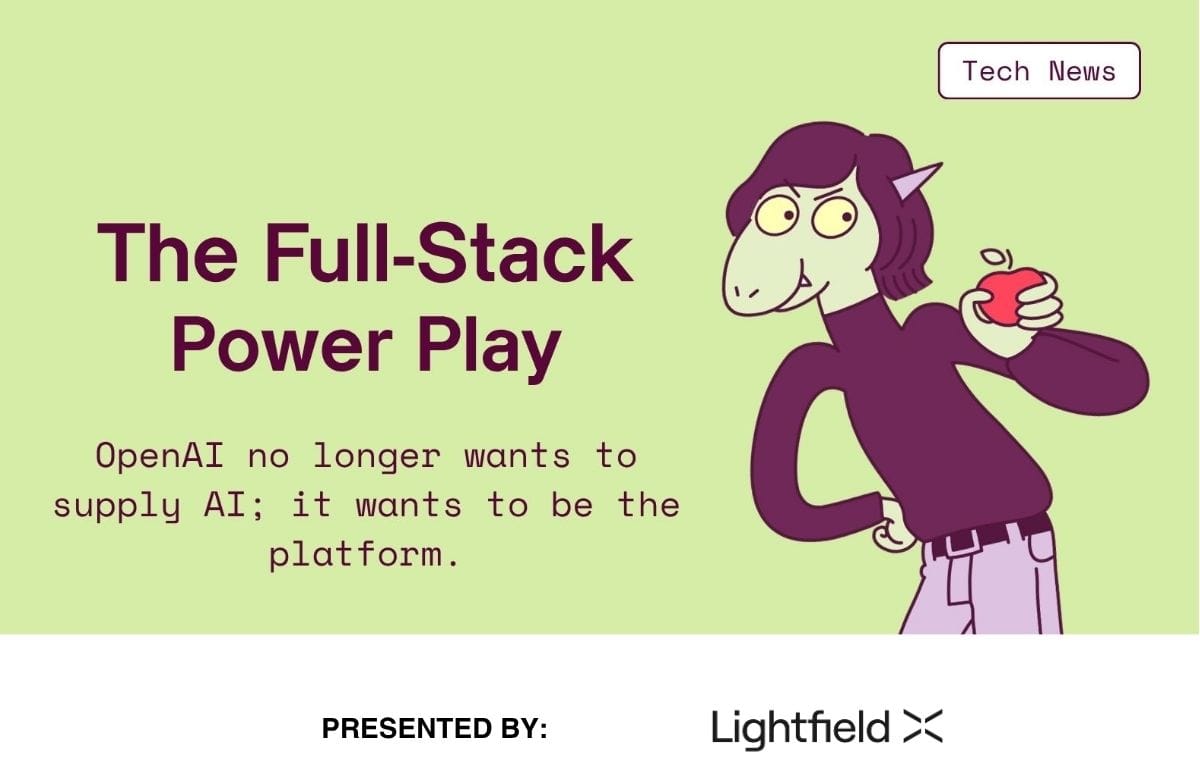
OpenAI's Apple Moment
Plus: Claude pays AI agents, Google's prompt warning, and AI saves seniors.

Roko's Basilisk
April 29, 2026
Here’s what’s on our plate today:
• 🧪 OpenAI's bid to own the full AI stack.
• 📰 Claude pays AI agents, Google's prompt warning, and AI saves seniors.
• 🧠 Brain Snack: build switching costs before OpenAI eats your layer.
• 🗳️ Poll: Will OpenAI's Apple-style playbook actually work?
Let’s dive in. No floaties needed…

Teach your CRM how you sell. It does the rest.

Lightfield, an AI-native CRM, just shipped Skills.
Describe any workflow in plain English—account research, deal scoring, call prep, pipeline forecasting—and your CRM learns it. Trigger it with one sentence.
"Prep me for my call with Acme." It pulls every email, transcript, and deal note. Write your brief.
"Score every deal in my pipeline." Done.
Teach it how you sell and watch it go to work for you. 2,500+ startups already have.
*This is sponsored content
The Laboratory
TL;DR
• From models to hardware: OpenAI is building custom AI chips with Broadcom, designing a screenless pocket device led by Jony Ive (acquired for $6.5B), and shipping smaller models for on-device use.
• The cost logic is real: Custom chips could cut computing costs by 30% to 40%, following the same playbook Amazon and Apple used to gain efficiency edges rivals couldn’t match.
• Hardware is humbling: Google Glass flopped, Humane’s AI Pin was panned, and Meta’s Ray-Bans remain niche. Excellence in AI research doesn’t guarantee consumer hardware success.
• IPO pressure shapes the narrative: With an $852B valuation, no expected profit until 2030, and $14B in projected 2026 losses, OpenAI needs a vertical-integration story that justifies a premium as public investors start demanding margins.
Why OpenAI wants to own the full AI stack
In technology, long-term advantage is built by companies that control the full path from production to user experience. Take, for instance, Apple; it did not become one of the most valuable companies in history by accident, as its edge came from tightly integrating hardware and software, from the chip inside its devices to the interface that users touch every day. That seamless integration turned technology into an experience people trusted and wanted, and it set a template that other ambitious companies have since tried to follow.

In the artificial intelligence space, OpenAI is now chasing a similar vision. Beyond building powerful models like ChatGPT, the company is designing its own AI chips, collaborating with former Apple designer Jony Ive on consumer devices, and rolling out smaller, more efficient models that can run directly on personal hardware.
Taken together, these efforts point to a significant shift in ambition, because OpenAI is no longer satisfied with supplying intelligence behind the scenes. It aims to shape how AI is built, delivered, and experienced end to end, much as Apple did with personal computing a generation earlier.
OpenAI’s shift from software to platform
In November 2025, Sam Altman offered a rare glimpse into OpenAI’s hardware ambitions during a conversation at Emerson Collective’s Demo Day. The company, he said, had finally built its first working prototypes, and he described the work as strikingly impressive, a reaction that suggested genuine surprise even from someone accustomed to breakthroughs.
While details about the device remain tightly guarded, the outlines are beginning to emerge. The device is expected to be small enough to fit in a pocket and, notably, may not have a screen. Instead of pulling users into yet another display, the device would rely on cameras and microphones to understand its surroundings, representing a fundamentally different approach to how people engage with technology.
The project is being led by Jony Ive, the designer who shaped Apple’s most iconic products over nearly three decades, after OpenAI acquired his startup, io, for $6.5B in May 2025. Altman has framed the idea as a deliberate break from the smartphone era, arguing that today’s devices constantly compete for attention, likening it to walking through Times Square. OpenAI’s vision, by contrast, is quieter and more restrained: a companion that works in the background, handles tasks over time, filters out noise, and steps in only when something truly matters.
In an interview with Nikkei Asia, Altman pushed the idea even further, suggesting that such a device could one day make smartphones unnecessary. It is a bold claim, but the notion that a single touchscreen slab could replace keyboards, cameras, and music players once sounded just as far-fetched.
Why cloud-only AI is not enough
And just as Apple had to work within fixed hardware constraints to reshape the smartphone market, OpenAI will have to find solutions to redefine how humans interact with its AI models without relying too heavily on cloud infrastructure.
Running powerful AI on a pocket-sized device takes more than smart software, because it also demands hardware designed specifically for the job, which is where OpenAI’s chip strategy comes into focus.
In October 2025, OpenAI announced a multibillion-dollar partnership with Broadcom to develop its own custom AI accelerators (chips designed to handle AI computations more efficiently than general-purpose processors). Unlike NVIDIA’s general-purpose GPUs (graphics processing units), these chips are being built expressly for OpenAI’s models, with the way those models function baked directly into the silicon.
The ambition behind the deal is hard to miss. The partnership covers 10 GW of AI computing capacity, with deployments planned over the next four years. OpenAI believes that designing its own chips could meaningfully reduce computing costs compared with relying on off-the-shelf hardware, an advantage that companies like Amazon have already demonstrated, achieving savings of 30% to 40% on specific workloads with custom silicon.
Altman has framed this as a chance to rethink the entire AI stack from the ground up, telling CNBC that designing the whole system together allows OpenAI to unlock major efficiency gains, from the transistor level to the token that comes out when a user asks ChatGPT a question. The comparison to Apple is deliberate because when Apple began designing its own M-series chips, it gained performance and efficiency advantages that rivals could not easily replicate. OpenAI is now betting that the same vertical integration can reshape how AI is built, deployed, and ultimately experienced.
The risks of going vertical
However, this is not a sure bet, since OpenAI’s strengths lie in AI research and software, not in chip design or shipping consumer hardware at scale.
As Electropages noted, NVIDIA has spent decades refining AI hardware, while OpenAI’s chip development program is still in its infancy. Making custom chips pay off will require more than manufacturing know-how, as it will truly demand years of careful software tuning to take full advantage of bespoke silicon.
The history of consumer tech is also full of cautionary tales that reinforce how difficult hardware can be. Google Glass never found a mainstream audience despite enormous hype. Meta’s AI-powered Ray-Bans remain a niche product with limited adoption. And in the AI space, Humane’s AI Pin arrived with big promises but received harsh reviews, demonstrating that being excellent at AI does not automatically translate into success in hardware.
At the same time, the timing of this vertical push is not accidental. OpenAI is preparing for an initial public offering as early as the fourth quarter of 2026, following its most recent funding round, which valued the company at $852B. For a company that does not expect to turn a profit until 2030 and is projecting $14B in losses for 2026 alone, the investor narrative matters enormously.
A credible hardware and chip strategy gives OpenAI something that pure software companies struggle to offer prospective shareholders: the promise of owning infrastructure rather than renting it, and a vertically integrated platform story that has historically commanded premium valuations in public markets. Apple’s own trajectory, from a computer maker to a trillion-dollar ecosystem company, is the clearest precedent. But the gap between presenting that story to investors and actually delivering on it remains wide, and public market investors will eventually demand margins, not just ambition.
Design, trust, and control
Beyond engineering, OpenAI is also facing deeper questions about the kind of product it wants to build. These include finding answers to things like how the device should behave in practice. How much should it know about its user, and where does data live? Who controls that information, and under what conditions? These are design and policy choices rather than purely technical ones, and they may take years to get right.
While OpenAI works through these challenges, others in the industry will be watching closely, because the answers could shape the competitive landscape for years to come.
For NVIDIA, this is a signal that even its biggest customers are slowly planning for greater independence. OpenAI will keep buying NVIDIA chips for years to come, but the direction of travel is clear, as the largest AI players want more control over the silicon their models run on.
OpenAI’s imitation game
At its core, OpenAI is following in the footsteps of companies like Apple, which secured its future by owning the full chain from silicon to user experience. OpenAI is now attempting a similar transformation for AI, pairing models, chips, and devices to ensure that AI is not just something people access through an app but something they live with seamlessly.
Whether OpenAI can execute on that vision remains an open question, given the enormous gap between building software and shipping hardware at a global scale. But the ambition itself signals something broader: AI is moving from software features to foundational platforms, and OpenAI wants to shape every layer of that transition.

Quick Bits, No Fluff
• Claude opens the wallet: Anthropic is letting Claude give AI agents money to close deals, the first real step toward agent-to-agent commerce.
• Web pages poisoning AI agents: Google is warning that malicious websites are now designed to hijack AI agents through hidden prompt injections.
• AI sensors save the elderly: A Dorset care home trial using AI motion and sound sensors cut falls by 49% and ambulance callouts by 64%.
Outperform the competition.
Business is hard. And sometimes you don’t really have the tools you need to be great at your job. Well, Open Source CEO is here to change that.
Tools & resources, ranging from playbooks, databases, courses, and more.
Deep dives on famous visionary leaders.
Interviews with entrepreneurs and playbook breakdowns.
Are you ready to see what’s all about?
*This is sponsored content
Brain Snack (for Builders)
 | If you’re building on top of OpenAI, assume the platform will eventually compete with you on hardware, distribution, and end-user experience. Build switching costs into your product, not your dependency on theirs. |
Wednesday Poll
🗳️ OpenAI is going full Apple. Will the playbook actually work? |
Meme Of The Day
The Toolkit
• Synthesize: No-code platform for building and monetizing AI-powered digital products without writing a line of code.
• Runway: AI video and image generation tool used by filmmakers and marketers to produce cinematic content from prompts.
• Tabnine: AI coding assistant that runs privately on your stack, useful for teams that can't send code to public AI services.
Rate This Edition
What did you think of today's email? |
