- Roko's Basilisk
- Posts
- Why ERP Is Becoming A Self-Driving Platform
Why ERP Is Becoming A Self-Driving Platform
An interview with Arnav Mishra, CTO of DOSS, on rebuilding ERP from the ground up with AI-native infrastructure and self-driving implementation

Roko's Basilisk
April 25, 2026

Why ERP Is Getting Its First Real Rebuild In 25 Years With Arnav Mishra
Welcome to Revenge of the Nerds. We’re skipping the hype and going straight to the builders. In this edition, we talked about:
• Arnav Mishra spent years watching companies get stuck in six-to-18-month ERP implementations that cost hundreds of thousands to millions of dollars—and realized the entire delivery model was broken at the infrastructure level.
• At DOSS, he's built an entirely new platform from the ground up: a custom database, a distributed systems layer, a managed metadata engine, and a declarative language that lets AI agents write ERP configurations the way Terraform writes infrastructure.
• The vision is full commoditization of business applications—where every company's back office runs on a single adaptive platform that never goes out of date with the business.
Let’s dive in. No floaties needed…

Goodies delivered straight into your inbox.

Get the chance to peek inside founders and leaders’ brains and see how they think about going beyond.
Join thousands of weekly readers at Google, OpenAI, Stripe, TikTok, Sequoia, and more.
Check all the tools and more here, and outperform the competition.
*This is sponsored content
Revenge of the Nerds
Arnav Mishra, Co-Founder & CTO of DOSS
Arnav is co-founder and CTO of DOSS, where he's building the AI-native operating system that's turning ERP from a multi-year implementation nightmare into a self-driving platform.

He got his start in databases and distributed systems at Rubrik, tried building his own startup on the side (and made every mistake in the book), then joined Sightline as one of the founding engineers. There, building billing software for construction, he kept hearing the same sales objection: prospective buyers were too busy going through ERP implementations to take meetings.

That sparked a deep dive into the ERP category that blew his mind. Arnav co-founded DOSS in late 2022 to rebuild the entire system from scratch—not as a better ERP, but as an adaptive resource platform that eliminates the gap between implementation and usage entirely.
ERPs are a long-standing industry. What did you see break that made you start DOSS?
My background before DOSS was working as one of the founding engineers at a company called Sightline, where we were building a billing solution for construction. One of the most common sales objections we'd get was that prospective buyers were too busy going through ERP implementations. I didn't know much about ERP at the time, so I spent years diving deep into the category.
What I found kind of blew my mind. The traditional method is that if you're a manufacturer—say you're making whiteboard markers—you go to Oracle, SAP, or Microsoft, and you get quoted six to 18 months on implementation timelines and hundreds of thousands to millions of dollars. That's the SMB to mid-market range. When you get larger, you're talking about five-to-10-year implementations costing tens to hundreds of millions of dollars.
The first thing we recognized was that ERPs are handcrafted, built as bespoke solutions for specific customers using old tooling. They're limited on delivery by a very scarce resource: humans who have the competency to map a business, build a system around it, and deliver it using last-generation tools. To me, that felt like going into AWS and being told I can have my infrastructure in a year and a half for $1M after someone sets it all up. That made no sense.

The underlying theme is that ERP implementation is separated from ERP usage. For most modern technology businesses, you're not going through a separate implementation over a lengthy period with a separate party. Your software just matches your business, adapts as you go, and enhances your ability to grow rather than inhibiting it.
What does implementation actually look like at DOSS compared to incumbents?
I describe DOSS as a three-phase business. Phase one was the first three-and-a-half years. The goal was to build a high-compute, high-scale HTAP database—hybrid transactional and analytical—combining the best parts of Postgres-type transactional databases with analytical databases like Snowflake and Databricks. On top of that, we built a distributed systems layer for running autonomous events that map business logic—issuing purchase orders, receiving sales orders, and generating invoices. And we built a managed metadata layer that tracks the schema of a company's business applications and the graph relationships between them.
Today, what we have is a system augmented by AI that allows for rapid implementation compared to incumbents. We're in a two-to-four-month implementation cycle with one to two people working on it, versus a 15-person, multi-year project.
Phase two is where everything changes. What today is human-driven with AI as augmentation becomes fully self-driving. Agents and sub-agents drive the entire implementation end-to-end. You go through a two-to-three-hour discovery session with the core operators who'll use the system. The AI asks specific questions, listens in the background, and drives the actual implementation so that by the end of the call—or within a few hours—you have the first set of modules in your hands. The additional work is mostly cosmetic: button placement, dashboard layouts, and which metrics to surface.
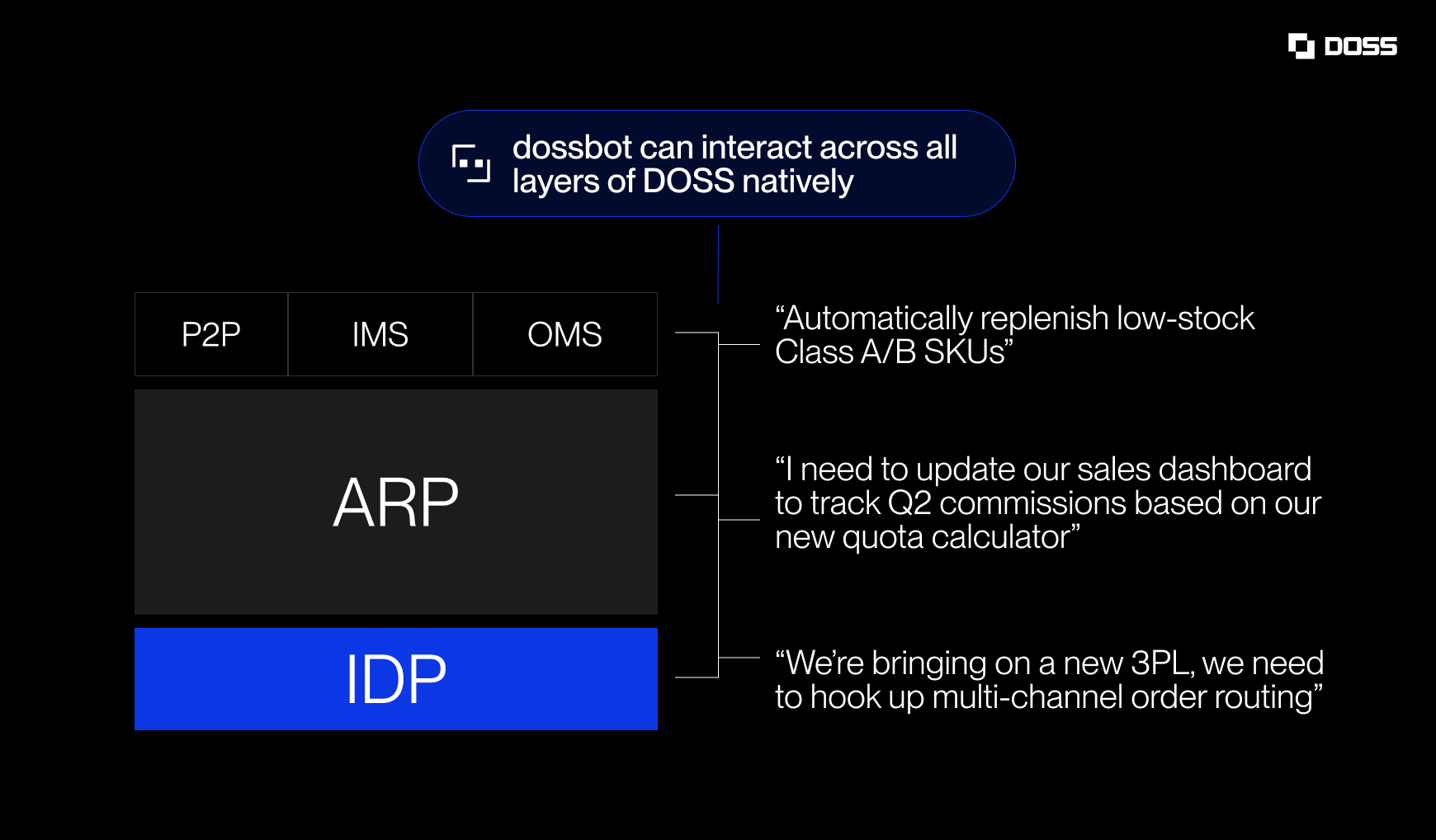
The core realization that makes this possible is that the thing AI is best at is writing code. If you're familiar with Terraform—the idea of defining infrastructure through a declarative language—we've done the same thing for ERP. We built our own custom language that defines business applications, is fully testable, has linting and type checking and compilation guarantees, and lets you set invariants for how a business should operate. Agents write code in this lower-dimensionality language rather than having access to all of JavaScript to build a business application. That's what enables the self-driving experience.
You call yourselves ARP instead of ERP. Is this a new category or an evolution?
It's an evolution in terms of marketing but an entire rebuild in terms of systems. To customers, we are an ERP solution—they've bought ERP for years and have a strong understanding of what it is. But the underlying system is entirely built from the ground up. ARP stands for Adaptive Resource Platform. At other times, it stands for AI—it depends on context.
The fundamental difference between an ERP and an ARP is what happens after you go live. Traditional ERP is built for a point in time. If you start contracting with Oracle in late 2025 and they deliver something by early 2027, they've built a solution that matches your business parameters at that moment. But by 2030, your business has changed—reshoring, new product lines, new distribution systems. The ERP no longer matches. You end up doing more and more work off-chain in Excel or separate tools, your source of truth fractures, and the only way to fix it is another six-to-12-month implementation.
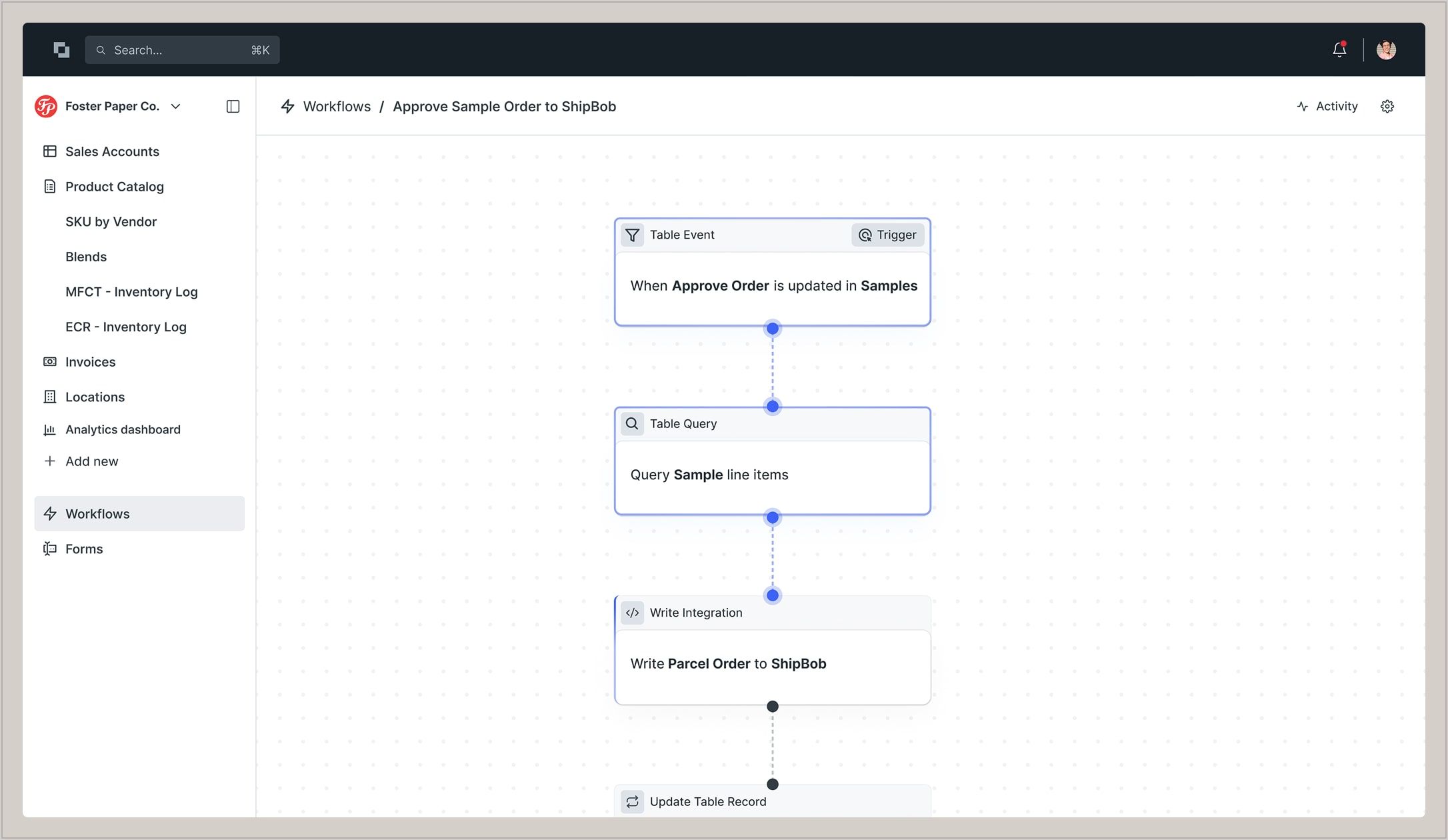
For us, adaptive means you never have to do that. The system is so easy to configure and so well managed that it never goes out of date with your business. A simple example: a lot of food and beverage businesses hit a point where raw materials are expiring and getting thrown away. Often it's because inventory is pulled FIFO—first in, first out—when what they actually need is FEFO: first expired, first out. Traditionally, making that change requires tracking expiration dates, restructuring how goods are pulled, and adjusting all the associated financial tracking. That's a multi-week project costing tens of thousands of dollars with a traditional ERP. You have to hire a McKinsey or a Deloitte to do it.
There's no reason in today's world why you can't go to your AI chatbot in the system, describe the change, and have it done in minutes or hours at worst. There can be a review process for approving changes to core systems. But the adaptability shouldn't be prevented by the lack of available human resources. It should be entirely scalable on compute. That's the industrialization of ERP delivery.
What industries are you focused on today?
I'd describe the first six to 12 months of our commercial journey as the first round of the buffet—we tried a little bit of everything. Construction, manufacturing, food and beverage, cosmetics, apparel, and all of CPG. We talked to companies under $5M in top line and billion-dollar businesses. What we found is that we liked everything. Everybody needed this. There was no better alternative in any space we worked with.
So we had to build a solution that works for every industry—that's why we built composable building blocks instead of fixed abstractions. But in the immediate term, we honed our marketing and sales around specific industries to scale more effectively. Today we're primarily focused on CPG brands in the $25M to $500M range—mostly $50M to $250M. Coffee companies, peanut butter brands, furniture businesses, home goods, and apparel.
These businesses generally have an online presence and an appetite for buying software. They're already working with Amazon, Shopify, and TikTok. They have existing software stacks. So the delivery speed is much faster. With the Series B, we'll invest in expanding into other markets. But the through-line is that anybody who has physical goods can be an ERP customer.
You just announced a Series B. What are the plans?
There are two bottlenecks to a business like ours. The first is trust. ERP is the single most important and most expensive software that most companies will ever buy. We're on a journey to build trust by proving value across a wide variety of companies over a time horizon that showcases historical success. Part of that is proving we have a balance sheet that can last us years—because if we go down for five minutes, companies can't run their businesses for five minutes. The risk of an ERP startup disappearing is too high for most buyers. Fundraising and capitalizing the business helps de-risk it dramatically. That's part of why we raised both a Series A and a Series B last year—it wasn't that we needed additional capital immediately, but the ability to go to market and showcase that we'll be around for a long time.

The second bottleneck is talent. We need first-principles thinkers on hard systems design problems. We're designing one of the first-ever agentic software development lifecycles. We're building Git repositories of ERP configuration files—that's never existed before. The capital helps us bring in the right people and take big swings against both our AI narratives and our core systems architecture.
And more capital lets us segment effectively across industries without creating a distraction.
If DOSS wins, what will a Fortune 500 company's back office look like in five to 10 years?
My co-founder is about to release a blog post on something adjacent to this. We think there will be two categories of businesses in the next five to 10 years: model companies and platform companies. Model companies are the OpenAIs and Anthropics. Platform companies are companies like us—the platform for business building.
People ask if SaaS is dead. Software building isn't dead in my mind. What might be dead at some time horizon is vertical SaaS. We're a platform company first. We built databases, distributed systems, and managed metadata layers. At no point have I said we built inventory management or procurement. Those are our applications. The platform upon which they stand is the interesting part.
What we're building is the ability to fully commoditize business applications at scale. We already have companies where you walk into an office, and there are 70 desks with 70 computers, and every single one just has DOSS on it. These 70 people are all doing different things for the business. There's no reason that shouldn't be possible at a 700-person company or a 7,000-person company—where every person's operating system for all their business application tooling lives inside DOSS.
Business applications should be a true commodity. The way our customers win should be based on product, people, and perspective—not on having a better inventory management solution. That shouldn't be the differentiating factor between businesses.
What makes this space so hard to enter & why do you think DOSS is well-positioned?
There's a very specific Venn diagram you need in order to build in this space. You need to know what an ERP is, which in the technology industry is not common. You need to know how ERP is used at scale for physical goods. Then you need to be an expert in AI systems, distributed systems, database systems, and systems of record at scale. You need a nuanced opinion on next-generation architecture.
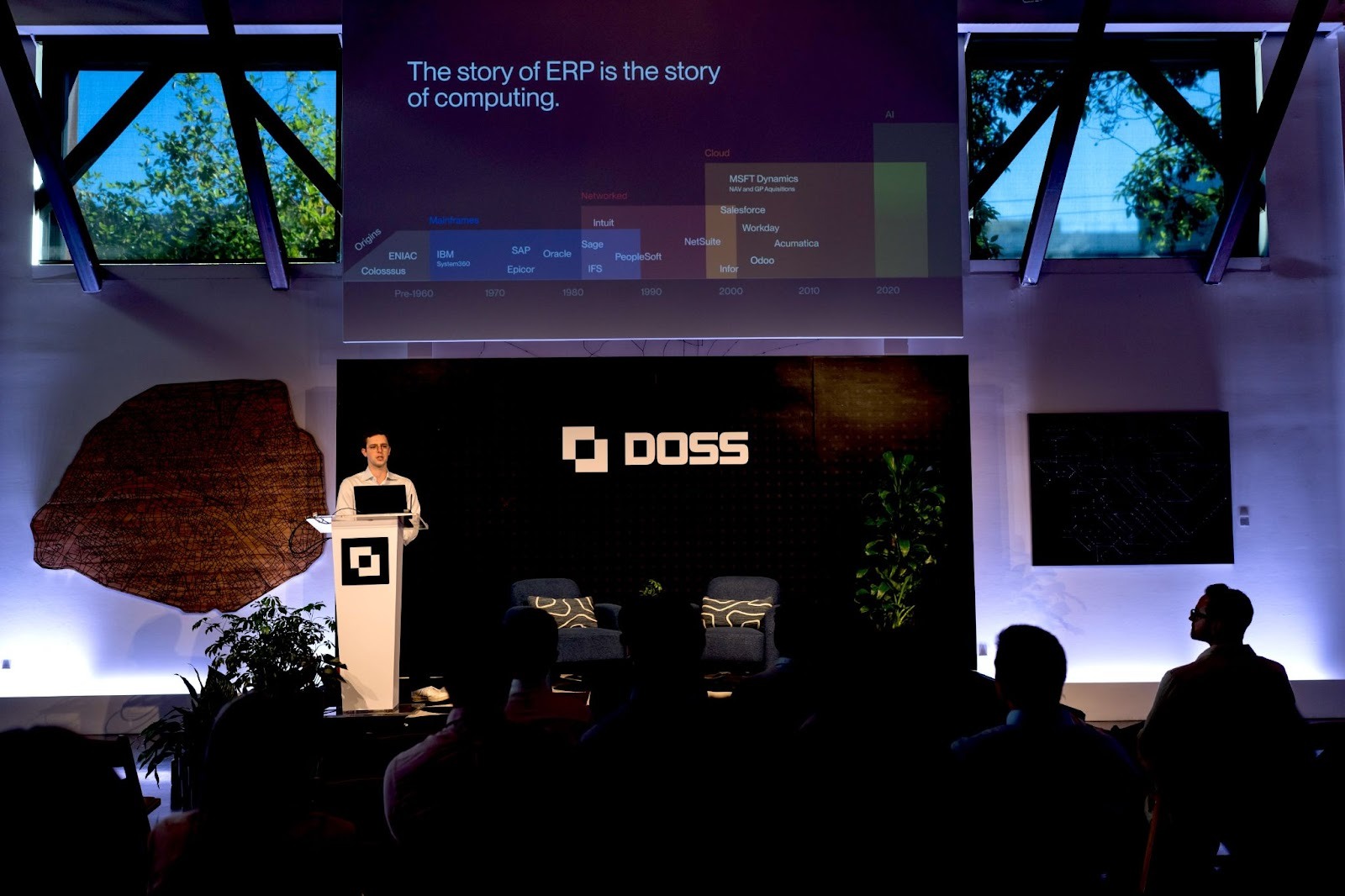
ERP has had a re-platforming every 20 years. It started with mainframes and IBM in the '60s, went to network PCs with Oracle and SAP in the '80s and '90s, then to cloud solutions with Microsoft and NetSuite in the 2000s. We're entering the next re-platforming in the 2020s with AI-based systems.
And the last piece: this is a category where you have to build a lot before you can sell. You need investors willing to back a business that won't have widespread commercial success six months after starting. Not many people can match up to the center of that Venn diagram. That's why we have no competitors in the market that were founded in the last 25 years. Every company building in this category today is building something adjacent or verticalized. The last companies doing this at our level were in the late '90s and early 2000s during the cloud re-platforming.

Additional Reads
Bessemer Venture Partners: Lessons from DOSS on building an 'anti-ERP ERP' platform.
DOSSCON1 on YouTube: Inside the case for the platform shift from ERP to ARP.
Raising.fi: DOSS Secures $55M in Series B to Enhance AI Inventory Management.
2026 Salary Report: U.S. vs Global hiring.
Want to know what world-class talent actually costs in 2026?
Athyna's Salary Report breaks down real salary data across AI, Tech, Data, Design, and more—so you can see exactly where the savings are.
The numbers might surprise you.
*This is sponsored content
Quick Poll
🗳️ Will AI-native platforms like DOSS make traditional ERP vendors (SAP, Oracle, NetSuite) obsolete within 10 years? |
Rate This Edition
What did you think of today's email? |